Head Creator Incentive Program
The new WTT regulations were rolled out, leading to changes in the rankings with Wang Chuqin instantly topping the men's list, while Sun Yingsha dropped to third. So, what's going on here?
The new WTT regulations were announced in 2024, and they will be implemented in the 2025 WTT Hong Kong Finals. The regulation is specifically designed for the 2025 end-of-year WTT event in Hong Kong.
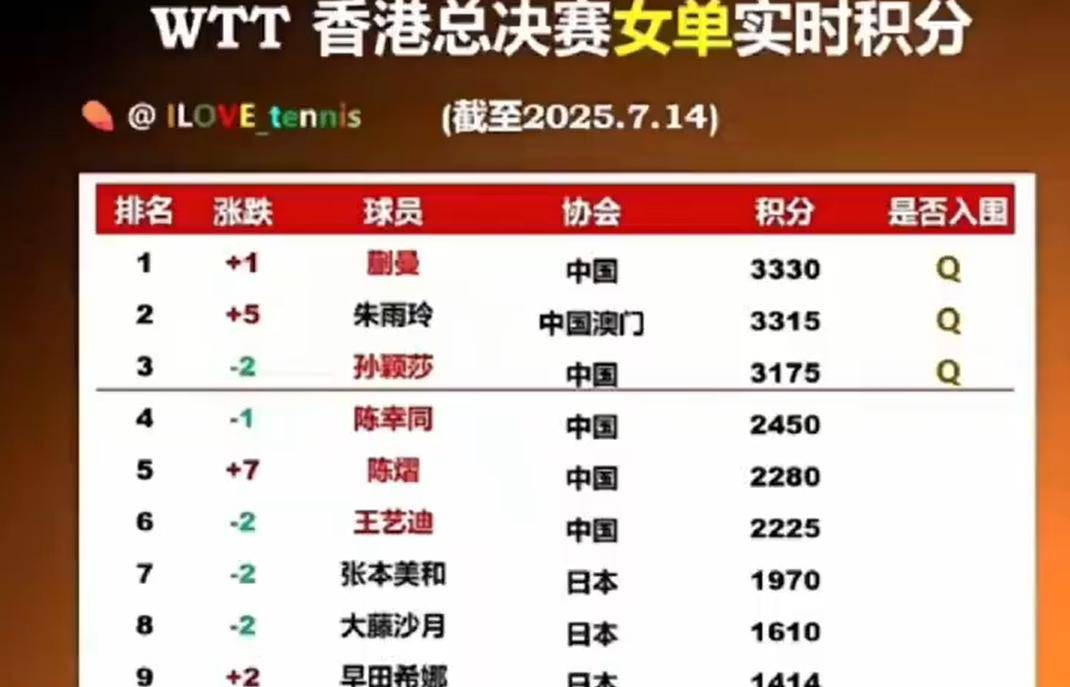
On July 21st, WTT released details about the points and rankings for the 2025 WTT Hong Kong Finals, which will mark the season's grand finale. Here’s a breakdown of the criteria for participation:
For singles, there will be 16 spots available for both men and women, awarded to the top 16 players based on the WTT Finals points standings. For mixed doubles, the top 7 ranked pairs will get the chance, alongside one wildcard pair from the host nation, totaling 8 pairs in action.
Players can only accumulate points through participation in WTT Series events. To qualify for singles, players must record their best results from 4 Grand Slam events, 4 Champion Series events, and 6 Challenge Series events. If there are insufficient results from the Challenge Series, the next best scores from the Regional Tours can be used as substitutes. For mixed doubles, the ranking will consider a player’s best performances in the Grand Slams and the 6 Challenge Series tournaments. If a qualified player fails to participate in an event, their points from that event are nullified.
In essence, the 2025 WTT Hong Kong Finals will not rely on the traditional world ranking system but instead will be based entirely on WTT event points. This system disregards the points from the three major international tournaments (Olympics, World Championships, and World Cup) and continental competitions. As a result, significant shifts in rankings are expected.
Let’s first look at the men’s rankings. Wang Chuqin, with a stellar performance in 2025, is currently ranked number one with 3700 points. His points include:
- 2000 points for winning the WTT US Grand Slam Men’s Singles
- 1000 points for his victory at the Chongqing Champion Series
- 700 points for his semifinal finish at the Singapore Grand Slam
Lin Shidong is in second place with 3400 points, followed by Tomokazu Harimoto at third with 3200 points. Felix Lebrun and Liang Jingkun are in the top tier as well.
The women’s rankings have seen more dramatic shifts. Kuai Man leads the standings with 3330 points, while Zhu Yuling follows closely with 3315 points. Sun Yingsha is in third place with 3175 points.

However, the world number two, Wang Manyu, is ranked only 16th under the new WTT system. It’s important to note that the 2025 season is not yet finished, and the final points tally will only be determined after the WTT Star Challenge in Muscat from November 17th to 22nd.
So, why is WTT making these changes, especially removing the points from the major international tournaments?
According to reports, many experts have raised concerns about the new WTT points system, particularly the exclusion of results from the three major tournaments. This decision means that the results of some important global events won’t affect the final standings, leading to drastic fluctuations in the rankings. WTT officials have justified this system, stating that it is designed to encourage players to participate in a full calendar of events rather than focusing only on the major tournaments.
WTT’s official stance on this is straightforward: \"This point system is designed to encourage players to actively participate in all events throughout the year, rather than solely concentrating on the bigger tournaments.\"
This sounds great on paper, but the underlying truth is much simpler: WTT is trying to attract top players with substantial prize money, aiming to establish itself as a powerful, independent commercial force in the world of table tennis.
On July 21st, WTT announced that the 2025 Hong Kong Finals would be held from December 10-14 at the Hong Kong Coliseum, with a grand prize pool of $1.3 million. While this is far from tennis-level prize money, it is quite high by table tennis standards. For professional players, prize money is a crucial source of income, and WTT hopes this substantial reward will attract elite players.
However, to play in the finals, athletes must participate in a series of WTT commercial events, adhering to WTT's specific rules. This approach is in line with WTT’s strong-arm tactics.
Does this approach have any flaws?
From WTT’s perspective, this strategy seems flawless. If players aren’t participating in WTT’s events, then they’re not eligible for the finals. It’s that simple. Whether you’re a top player or not, if you don’t engage with WTT’s events, you’re out of the equation.

What about the high-value points from the three major tournaments? Simple: just remove them. And so, that’s exactly what WTT did.
But what’s the problem with this approach?
There are some significant issues. For one, WTT is now completely detached from the International Table Tennis Federation (ITTF) ranking system. The world rankings should be the most authoritative, including WTT points, but by excluding the points from major tournaments, WTT has essentially created a parallel system. This raises the question: if the WTT Finals points don’t include major tournament results, should the world rankings?
Many elite players, for various reasons, may not participate in WTT events, thus losing their chance to qualify for the finals. This seems unfair, particularly when the world ranking should consider all events, not just those that benefit WTT.
Since its inception, WTT has faced intense scrutiny. There are many criticisms surrounding its mandatory participation rules, fines, event density, high-point system, and issues regarding prize payouts and financial transparency. The mandatory participation rule has led to the withdrawal of top stars like Fan Zhendong, Ma Long, and Chen Meng from the world rankings. Furthermore, Liu Guoliang’s decision to step down as head of the Chinese Table Tennis Association and dedicate himself fully to the promotion of WTT is indicative of the system's aggressive nature.
The changes to the end-of-year points system are clearly aligned with Liu Guoliang’s vision for WTT. His strong leadership style and commitment to making WTT a commercially successful venture are evident in the direction he is taking. WTT is focused on becoming an independent commercial force in the table tennis world, and it’s clear that Liu Guoliang will continue pushing this agenda with his unique approach and perspective.