贝叶斯优化(Bayesian Optimization, BO)虽然是超参数调优的利器,但在实际落地中往往会出现收敛慢、计算开销大等问题。很多时候直接“裸跑”标准库里的 BO,效果甚至不如多跑几次 Random Search。
所以要想真正发挥 BO 的威力,必须在搜索策略、先验知识注入以及计算成本控制上做文章。本文整理了十个经过实战验证的技巧,能帮助优化器搜索得更“聪明”,收敛更快,显著提升模型迭代效率。
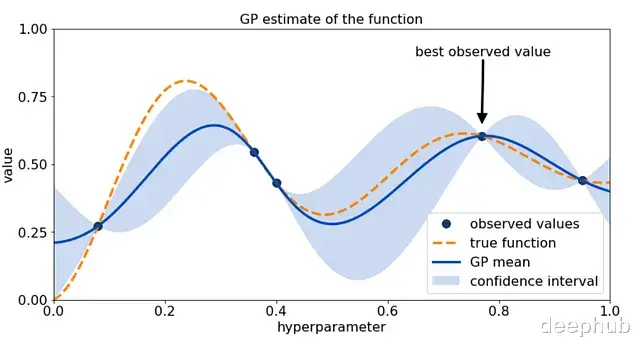
千万别冷启动,优化器如果在没有任何线索的情况下开始,为了探索边界会浪费大量算力。既然我们通常对超参数范围有一定领域知识,或者手头有类似的过往实验数据,就应该利用起来。
弱先验会导致优化器在搜索空间中漫无目的地游荡,而强先验能迅速坍缩搜索空间。在昂贵的 ML 训练循环中,先验质量直接决定了你能省下多少 GPU 时间。
所以可以先跑一个微型的网格搜索或随机搜索(比如 5-10 次试验),把表现最好的几个点作为先验,去初始化高斯过程(Gaussian Process)。
利用知情先验初始化高斯过程
import numpy as np from sklearn.gaussian_process import GaussianProcessRegressor from sklearn.gaussian_process.kernels import Matern from skopt import Optimizer # Step 1: Quick cheap search to build priors def objective(params): lr, depth = params return train_model(lr, depth) # your training loop returning validation loss search_space = [ (1e-4, 1e-1), # learning rate (2, 10) # depth ] # quick 8-run grid/random search initial_points = [ (1e-4, 4), (1e-3, 4), (1e-2, 4), (1e-4, 8), (1e-3, 8), (1e-2, 8), (5e-3, 6), (8e-3, 10) ] initial_results = [objective(p) for p in initial_points] # Step 2: Build priors for Bayesian Optimization kernel = Matern(nu=2.5) gp = GaussianProcessRegressor(kernel=kernel, normalize_y=True) # Step 3: Initialize optimizer with priors opt = Optimizer( dimensions=search_space, base_estimator=gp, initial_point_generator="sobol", ) # Feed prior observations for p, r in zip(initial_points, initial_results): opt.tell(p, r) # Step 4: Bayesian Optimization with informed priors for _ in range(30): next_params = opt.ask() score = objective(next_params) opt.tell(next_params, score) best_params = opt.get_result().x print("Best Params:", best_params)
有 Kaggle Grandmaster 曾通过复用相似问题的先验配置,减少了 40% 的调优轮次。用几次廉价的评估换取贝叶斯搜索的加速,这笔交易很划算。
2、动态调整采集函数(Acquisition Function)Expected Improvement (EI) 是最常用的采集函数,因为它在“探索”和“利用”之间取得了不错的平衡。但在搜索后期,EI 往往变得过于保守,导致收敛停滞。
搜索策略不应该是一成不变的。当发现搜索陷入平原区时,可以尝试动态切换采集函数:在需要激进逼近最优解时切换到 UCB(Upper Confidence Bound);在搜索初期或者目标函数噪声较大需要跳出局部优时,切换到 PI(Probability of Improvement)。
动态调整策略能有效打破后期平台期,减少那些对模型提升毫无帮助的“垃圾时间”。这里用 scikit-optimize 演示如何根据收敛情况动态切换策略:
import numpy as np from skopt import Optimizer from skopt.acquisition import gaussian_ei, gaussian_pi, gaussian_ucb # Dummy expensive objective def objective(params): lr, depth = params return train_model(lr, depth) # Replace with your actual training loop space = [(1e-4, 1e-1), (2, 10)] opt = Optimizer( dimensions=space, base_estimator="GP", acq_func="EI" # initial acquisition function ) def should_switch(iteration, recent_scores): # Simple heuristic: if scores haven't improved in last 5 steps, switch mode if iteration > 10 and np.std(recent_scores[-5:]) < 1e-4: return True return False scores = [] for i in range(40): # Dynamically pick acquisition function if should_switch(i, scores): # Choose UCB when nearing convergence, PI for risky exploration opt.acq_func = "UCB" if scores[-1] < np.median(scores) else "PI" x = opt.ask() y = objective(x) scores.append(y) opt.tell(x, y) best_params = opt.get_result().x print("Best Params:", best_params)
3、善用对数变换(Log Transforms)很多超参数(如学习率、正则化强度、Batch Size)在数值上跨越了几个数量级,呈现指数分布。这种分布对高斯过程(GP)非常不友好,因为 GP 假设空间是平滑均匀的。
直接在原始空间搜索,优化器会把大量时间浪费在拟合那些陡峭的“悬崖”上。对这些参数进行对数变换(Log Transform),把指数空间拉伸成线性的,让优化器在一个“平坦”的操场上跑。这不仅能稳定 GP 的核函数,还能大幅降低曲率,在实际调参中通常能把收敛时间减半。
import numpy as np from skopt import Optimizer from skopt.space import Real # Expensive training function def objective(params): log_lr, log_reg = params lr = 10 ** log_lr # inverse log transform reg = 10 ** log_reg return train_model(lr, reg) # replace with your actual training loop # Step 1: Define search space in log10 scale space = [ Real(-5, -1, name="log_lr"), # lr in [1e-5, 1e-1] Real(-6, -2, name="log_reg") # reg in [1e-6, 1e-2] ] # Step 2: Create optimizer with log-transformed space opt = Optimizer( dimensions=space, base_estimator="GP", acq_func="EI" ) # Step 3: Run Bayesian Optimization entirely in log-space n_iters = 40 scores = [] for _ in range(n_iters): x = opt.ask() # propose in log-space y = objective(x) # evaluate in real-space opt.tell(x, y) scores.append(y) best_log_params = opt.get_result().x best_params = { "lr": 10 ** best_log_params[0], "reg": 10 ** best_log_params[1] } print("Best Params:", best_params)
4、别让 BO 陷入“套娃”陷阱(Hyper-hypers)贝叶斯优化本身也是有超参数的:Kernel Length Scales、噪声项、先验方差等。如果你试图去优化这些参数,就会陷入“为了调参而调参”的无限递归。
BO 内部的超参数优化非常敏感,容易导致代理模型过拟合或者噪声估计错误。对于工业级应用,更稳健的做法是早停(Early Stopping)GP 的内部优化器,或者直接使用元学习(Meta-Learning)得出的经验值来初始化这些超-超参数。这能让代理模型更稳定,更新成本更低,AutoML 系统通常都采用这种策略而非从零学起。
import numpy as np from skopt import Optimizer from sklearn.gaussian_process import GaussianProcessRegressor from sklearn.gaussian_process.kernels import Matern, WhiteKernel # Meta-learned priors from previous similar tasks meta_length_scale = 0.3 meta_noise_level = 1e-3 kernel = ( Matern(length_scale=meta_length_scale, nu=2.5) + WhiteKernel(noise_level=meta_noise_level) ) # Early-stop BO's own hyperparameter tuning gp = GaussianProcessRegressor( kernel=kernel, optimizer="fmin_l_bfgs_b", n_restarts_optimizer=0, # Crucial: prevent expensive hyper-hyper loops normalize_y=True ) # BO with a stable, meta-initialized GP opt = Optimizer( dimensions=[(1e-4, 1e-1), (2, 12)], base_estimator=gp, acq_func="EI" ) def objective(params): lr, depth = params return train_model(lr, depth) # your model's validation loss scores = [] for _ in range(40): x = opt.ask() y = objective(x) opt.tell(x, y) scores.append(y) best_params = opt.get_result().x print("Best Params:", best_params)
5、惩罚高成本区域标准的 BO 只在乎准确率,不在乎你的电费单。有些参数组合(比如超大 Batch Size、极深的网络、巨大的 Embedding 维度)可能只会带来微小的性能提升,但计算成本却是指数级增长的。
如果不管控成本,BO 很容易钻进“高分低能”的牛角尖。所以可以修改采集函数,引入成本惩罚项。我们不看绝对性能,而是看单位成本的性能收益。斯坦福 ML 实验室曾指出,忽略成本感知会导致预算超支 37% 以上。
成本感知的采集函数(Cost-Aware EI)
import numpy as np from skopt import Optimizer from skopt.acquisition import gaussian_ei # Objective returns BOTH validation loss and estimated training cost def objective(params): lr, depth = params val_loss = train_model(lr, depth) cost = estimate_cost(lr, depth) # e.g., GPU hours or FLOPs proxy return val_loss, cost # Custom cost-aware EI: maximize EI / Cost def cost_aware_ei(model, X, y_min, costs): raw_ei = gaussian_ei(X, model, y_min=y_min) normalized_costs = costs / np.max(costs) penalty = 1.0 / (1e-6 + normalized_costs) return raw_ei * penalty # Search space opt = Optimizer( dimensions=[(1e-4, 1e-1), (2, 20)], base_estimator="GP" ) observed_losses = [] observed_costs = [] for _ in range(40): # Ask a batch of candidate points candidates = opt.ask(n_points=20) # Evaluate cost-aware EI for each candidate y_min = np.min(observed_losses) if observed_losses else np.inf cost_scores = cost_aware_ei( opt.base_estimator_, np.array(candidates), y_min=y_min, costs=np.array(observed_costs[-len(candidates):] + [1]*len(candidates)) # fallback cost=1 ) # Pick best candidate under cost-awareness next_x = candidates[np.argmax(cost_scores)] (loss, cost) = objective(next_x) observed_losses.append(loss) observed_costs.append(cost) opt.tell(next_x, loss) best_params = opt.get_result().x print("Best Params (Cost-Aware):", best_params)
6、混合策略:BO + 随机搜索在噪声较大的任务(如 RL 或深度学习训练)中,BO 并非无懈可击。GP 代理模型有时候会被噪声“骗”了,导致对错误的区域过度自信,陷入局部最优。
这时候引入一点“混乱”反而有奇效。在 BO 循环中混入约 10% 的随机搜索,能有效打破代理模型的“执念”,增加全局覆盖率。这是一种用随机性的多样性来弥补 BO 确定性缺陷的混合策略,也是很多大规模 AutoML 系统的默认配置。
随机-BO 混合模式
import numpy as np from skopt import Optimizer from skopt.space import Real, Integer # Define search space space = [ Real(1e-4, 1e-1, name="lr"), Integer(2, 12, name="depth") ] # Expensive training loop def objective(params): lr, depth = params return train_model(lr, depth) # your model's validation loss # BO Optimizer opt = Optimizer( dimensions=space, base_estimator="GP", acq_func="EI" ) n_total = 50 n_random = int(0.20 * n_total) # first 20% = random exploration results = [] for i in range(n_total): if i < n_random: # ----- Phase 1: Pure Random Search ----- x = [ np.random.uniform(1e-4, 1e-1), np.random.randint(2, 13) ] else: # ----- Phase 2: Bayesian Optimization ----- x = opt.ask() y = objective(x) results.append((x, y)) # Only tell BO after evaluations (keeps history consistent) opt.tell(x, y) best_params = opt.get_result().x print("Best Params (Hybrid):", best_params)
7、并行化:伪装成并行计算BO 本质上是串行的(Sequential),因为每一步都依赖上一步更新的后验分布。这在多 GPU 环境下很吃亏。不过我们可以“伪造”并行性。
启动多个独立的 BO 实例,给它们设置不同的随机种子或先验。让它们独立跑,然后把结果汇总到一个主 GP 模型里进行 Retrain。这样既利用了并行计算资源,又通过多样化的探索增强了最终代理模型的适应性。这种方法在 NAS(神经网络架构搜索)中非常普遍。
多路并行 BO + 结果合并
import numpy as np from skopt import Optimizer from multiprocessing import Pool # Search space space = [(1e-4, 1e-1), (2, 10)] # Expensive objective def objective(params): lr, depth = params return train_model(lr, depth) # Create BO instances with different priors/kernels def make_optimizer(seed): return Optimizer( dimensions=space, base_estimator="GP", acq_func="EI", random_state=seed ) optimizers = [make_optimizer(seed) for seed in [0, 1, 2, 3]] # 4 BO tracks # Evaluate one BO step for a single optimizer def bo_step(opt): x = opt.ask() y = objective(x) opt.tell(x, y) return (x, y) # Run pseudo-parallel BO for N steps def run_parallel_steps(optimizers, steps=10): pool = Pool(len(optimizers)) results = [] for _ in range(steps): async_calls = [pool.apply_async(bo_step, (opt,)) for opt in optimizers] for res, opt in zip(async_calls, optimizers): x, y = res.get() results.append((x, y)) pool.close() pool.join() return results # Step 1: parallel exploration parallel_results = run_parallel_steps(optimizers, steps=15) # Step 2: merge results into a master BO master = make_optimizer(seed=99) for x, y in parallel_results: master.tell(x, y) # Step 3: refine with unified BO for _ in range(30): x = master.ask() y = objective(x) master.tell(x, y) print("Best Params:", master.get_result().x)
8、非数值输入的处理技巧高斯过程喜欢连续平滑的空间,但现实中的超参数往往包含非数值型变量(如优化器类型:Adam vs SGD,激活函数类型等)。这些离散的“跳跃”会破坏 GP 的核函数假设。
直接把它们当类别 ID 输入给 GP 是错误的。正确的做法是使用 One-Hot 编码 或者 Embedding。将类别变量映射到连续的数值空间,让 BO 能理解类别之间的“距离”,从而恢复搜索空间的平滑性。在一个 BERT 微调的案例中,仅仅通过正确编码 adam_vs_sgd,就带来了 15% 的性能提升。
处理类别型超参数
import numpy as np from skopt import Optimizer from sklearn.preprocessing import OneHotEncoder # --- Step 1: Prepare categorical encoder --- optimizers = np.array([["adam"], ["sgd"], ["adamw"]]) enc = OneHotEncoder(sparse_output=False).fit(optimizers) def encode_category(cat_name): return enc.transform([[cat_name]])[0] # returns continuous 3-dim vector # --- Step 2: Combined numeric + categorical search space --- # Continuous params: lr, dropout # Encoded categorical: optimizer space_dims = [ (1e-5, 1e-2), # learning rate (0.0, 0.5), # dropout (0.0, 1.0), # optimizer_onehot_dim1 (0.0, 1.0), # optimizer_onehot_dim2 (0.0, 1.0) # optimizer_onehot_dim3 ] opt = Optimizer( dimensions=space_dims, base_estimator="GP", acq_func="EI" ) # --- Step 3: Objective that decodes embedding back to category --- def decode_optimizer(vec): idx = np.argmax(vec) return ["adam", "sgd", "adamw"][idx] def objective(params): lr, dropout, *opt_vec = params opt_name = decode_optimizer(opt_vec) return train_model(lr, dropout, optimizer=opt_name) # --- Step 4: Hybrid categorical-continuous BO loop --- for _ in range(40): x = opt.ask() # Snap encoded optimizer vector to nearest valid one-hot opt_vec = np.array(x[2:]) snapped_vec = np.zeros_like(opt_vec) snapped_vec[np.argmax(opt_vec)] = 1.0 clean_x = [x[0], x[1], *snapped_vec] y = objective(clean_x) opt.tell(clean_x, y) best_params = opt.get_result().x print("Best Params:", best_params)
9、约束不可探索区域很多超参数组合理论上存在,但工程上跑不通。比如 batch_size 大于数据集大小,或者 num_layers < num_heads 等逻辑矛盾。如果不对其进行约束,BO 会浪费大量时间去尝试这些必然报错或无效的组合。
通过显式地定义约束条件,或者在目标函数中对无效区域返回一个巨大的 Loss,可以迫使 BO 避开这些“雷区”。这能显著减少失败的试验次数,通常能节省 25-40% 的搜索时间。
约束感知的贝叶斯优化
from skopt import gp_minimize from skopt.space import Integer, Real, Categorical import numpy as np # Hyperparameter search space space = [ Integer(8, 512, name="batch_size"), Integer(1, 12, name="num_layers"), Integer(1, 12, name="num_heads"), Real(1e-5, 1e-2, name="learning_rate", prior="log-uniform"), ] # Define constraints def valid_config(params): batch_size, num_layers, num_heads, _ = params return (batch_size <= 12800) and (num_layers >= num_heads) # Wrapped objective that enforces constraints def objective(params): if not valid_config(params): # Penalize invalid regions so BO learns to avoid them return 10.0 # large synthetic loss # Fake expensive training loop batch_size, num_layers, num_heads, lr = params loss = ( (num_layers - num_heads) * 0.1 + np.log(batch_size) * 0.05 + np.random.normal(0, 0.01) + lr * 5 ) return loss # Run constraint-aware BO result = gp_minimize( func=objective, dimensions=space, n_calls=40, n_initial_points=8, noise=1e-5 ) print("Best hyperparameters:", result.x)
10、集成代理模型(Ensemble Surrogate Models)单一的高斯过程模型并不总是可靠的。面对高维空间或稀疏数据,GP 容易产生“幻觉”,给出错误的置信度估计。
更稳健的做法是集成多个代理模型。我们可以同时维护 GP、随机森林(Random Forest)和梯度提升树(GBDT),甚至简单的 MLP。通过投票或加权平均来决定下一步的搜索方向。这利用了集成学习的优势,显著降低了预测方差。在 Optuna 等成熟框架中,这种思想被广泛应用。
import optuna from sklearn.gaussian_process import GaussianProcessRegressor from sklearn.ensemble import RandomForestRegressor, GradientBoostingRegressor import numpy as np # Build surrogate ensemble def build_surrogates(): return [ GaussianProcessRegressor(normalize_y=True), RandomForestRegressor(n_estimators=200), GradientBoostingRegressor() ] # Train all surrogates on past trials def train_surrogates(surrogates, X, y): for s in surrogates: s.fit(X, y) # Aggregate predictions using uncertainty-aware weighting def ensemble_predict(surrogates, X): preds = [] for s in surrogates: p = s.predict(X, return_std=False) preds.append(p) return np.mean(preds, axis=0) def objective(trial): # Hyperparameters lr = trial.suggest_loguniform("lr", 1e-5, 1e-2) depth = trial.suggest_int("depth", 2, 8) # Fake expensive evaluation loss = (depth * 0.1) + (np.log1p(1/lr) * 0.05) + np.random.normal(0, 0.02) return loss # Custom sampling strategy that ensembles surrogate predictions class EnsembleSampler(optuna.samplers.BaseSampler): def __init__(self): self.surrogates = build_surrogates() def infer_relative_search_space(self, study, trial): return None # use independent sampling def sample_relative(self, study, trial, search_space): return {} def sample_independent(self, study, trial, param_name, distribution): trials = study.get_trials(deepcopy=False) # Warm-up phase: random sampling if len(trials) < 15: return optuna.samplers.RandomSampler().sample_independent( study, trial, param_name, distribution ) # Collect training data X = [] y = [] for t in trials: if t.values: X.append([t.params["lr"], t.params["depth"]]) y.append(t.values[0]) X = np.array(X) y = np.array(y) train_surrogates(self.surrogates, X, y) # Generate candidate points candidates = np.random.uniform( low=distribution.low, high=distribution.high, size=64 ) # Predict surrogate losses if param_name == "lr": Xcand = np.column_stack([candidates, np.full_like(candidates, trial.params.get("depth", 5))]) else: Xcand = np.column_stack([np.full_like(candidates, trial.params.get("lr", 1e-3)), candidates]) preds = ensemble_predict(self.surrogates, Xcand) # Pick best predicted candidate return float(candidates[np.argmin(preds)]) # Run ensemble-driven BO study = optuna.create_study(sampler=EnsembleSampler(), direction="minimize") study.optimize(objective, n_trials=40) print("Best:", study.best_params)
总结直接调用现成的库往往难以解决复杂的工业级问题。上述这十个技巧,本质上都是在弥合理论假设(如平滑性、无限算力、同质噪声)与工程现实(如预算限制、离散参数、失败试验)之间的鸿沟。
在实际应用中,不要把贝叶斯优化当作一个不可干预的黑盒。它应该是一个可以深度定制的组件。只有当你根据具体问题的特性,去精心设计搜索空间、调整采集策略并引入必要的约束时,贝叶斯优化才能真正成为提升模型性能的加速器,而不是消耗 GPU 资源的无底洞。
https://avoid.overfit.cn/post/bb15da0bacca46c4b0f6a858827b242f